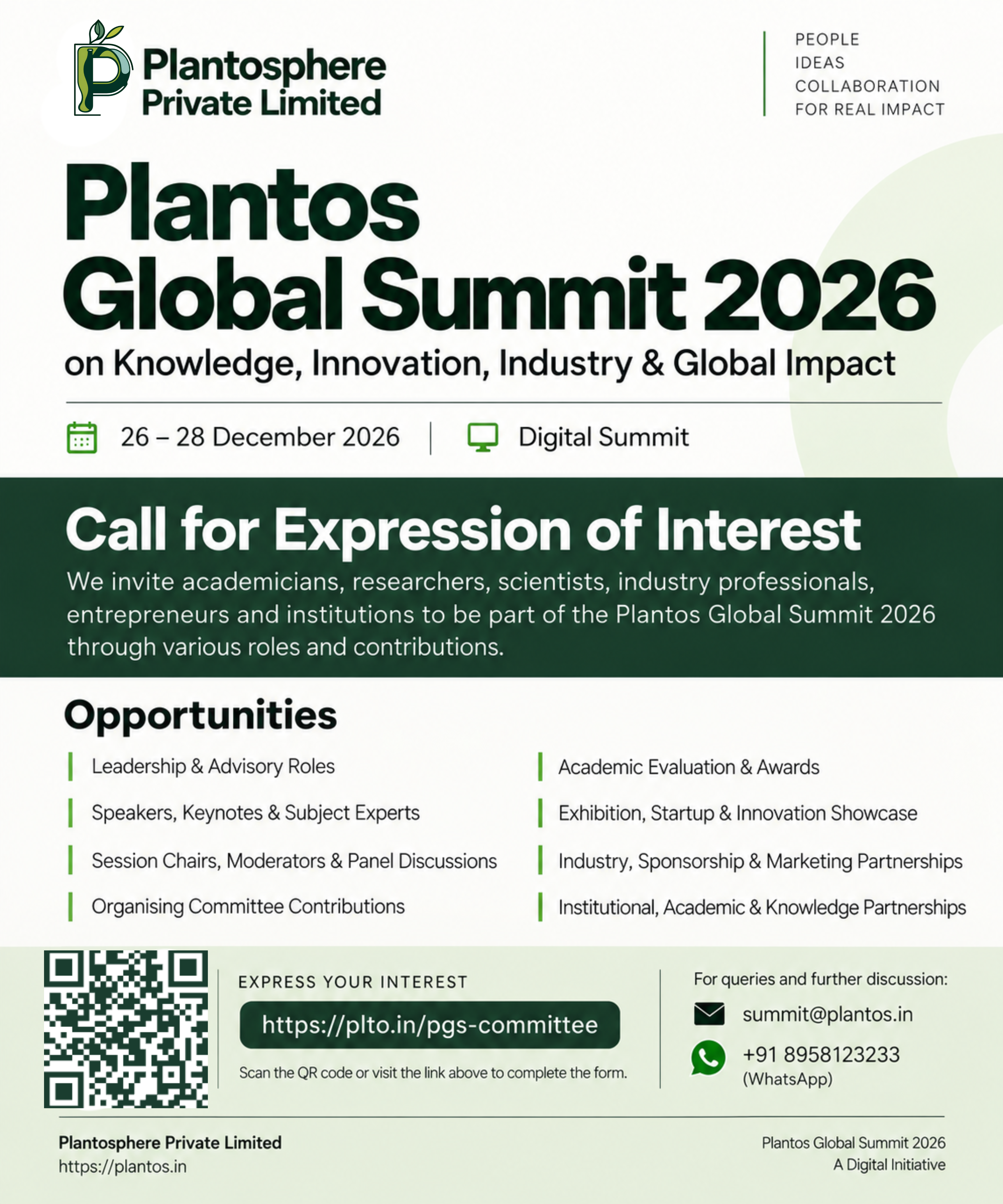
The window to become part of 𝗣𝗹𝗮𝗻𝘁𝗼𝘀 𝗚𝗹𝗼𝗯𝗮𝗹 𝗦𝘂𝗺𝗺𝗶𝘁 𝟮𝟬𝟮𝟲 is closing soon.
We are in the final phase of inviting professionals, academicians, researchers, industry experts and students to join the summit through various roles and opportunities.
APPLICATIONS ARE OPEN FOR:
• Academicians, Researchers & Scientists
• Speakers, Advisors & Subject Experts
• Industry Professionals & Institutional Partners
• Organising Committee Members
• Campus Ambassadors & Student Volunteers
𝗙𝗶𝗻𝗮𝗹 𝗗𝗮𝘁𝗲: 𝟮𝟴 𝗡𝗼𝘃𝗲𝗺𝗯𝗲𝗿 𝟮𝟬𝟮𝟲
Only a few days remain. The Expression of Interest form will close after this deadline, and applications will no longer be accepted through the current window.
If you have been considering getting involved, this is the right time to take the next step.
𝗔𝗽𝗽𝗹𝘆 𝗛𝗲𝗿𝗲:
https://lnkd.in/dvaJHXqH
𝗤𝘂𝗲𝗿𝗶𝗲𝘀: summit@plantos.in
𝗪𝗵𝗮𝘁𝘀𝗔𝗽𝗽: +91 89581 23233
𝗣𝗹𝗮𝗻𝘁𝗼𝘀 𝗚𝗹𝗼𝗯𝗮𝗹 𝗦𝘂𝗺𝗺𝗶𝘁 𝟮𝟬𝟮𝟲
Organised by 𝗣𝗹𝗮𝗻𝘁𝗼𝘀𝗽𝗵𝗲𝗿𝗲 𝗣𝗿𝗶𝘃𝗮𝘁𝗲 𝗟𝗶𝗺𝗶𝘁𝗲𝗱
https://plantos.in
MAH-20-45 is a newly released maize hybrid developed by the University of Agricultural Sciences, Bengaluru (UAS-B). It is an improved hybrid derived from the earlier hybrid MAH-14-5.
It was released during the Bengaluru Krishi Mela in November 2026.
𝗟𝗶𝘁𝗼𝗿𝗮 𝗨𝗽𝗱𝗮𝘁𝗲: 𝗜𝗻𝘁𝗿𝗼𝗱𝘂𝗰𝗶𝗻𝗴 𝗩𝗼𝗰𝗮𝗹𝗶𝗰𝘀 𝗔𝗿𝗲𝗻𝗮
We have released a new version of Litora with several improvements, bug fixes and a new interactive feature: Vocalics Arena.
𝗪𝗵𝗮𝘁'𝘀 𝗡𝗲𝘄?
Vocalics Arena introduces live voice rooms where users can join a stage, take an available seat and interact with other participants.
The experience currently includes:
• Live voice stages with multiple participant seats.
• Host controls to invite participants, manage seats and mute seats.
• Interactive room chat.
• Q&A and polls.
• Options to join and participate in live conversations.
Alongside this, we have resolved several existing issues and improved the overall app experience.
𝗛𝗼𝘄 𝘁𝗼 𝗔𝗰𝗰𝗲𝘀𝘀 𝗩𝗼𝗰𝗮𝗹𝗶𝗰𝘀 𝗔𝗿𝗲𝗻𝗮?
Update Litora from the Google Play Store, open the Explore tab and select Vocalics Arena. Enter either of the available rooms and join an open seat using the "Switch to this Seat" option.
This is another step in making Litora a more interactive space for conversations, discussions and community participation. We will continue refining the experience and introducing more capabilities in future updates.
𝗧𝗿𝘆 𝘁𝗵𝗲 𝗟𝗮𝘁𝗲𝘀𝘁 𝗨𝗽𝗱𝗮𝘁𝗲:
https://play.google.com/store/apps/details?id=in.litora.app
If you are already using Litora, update the app and explore the new experience. We welcome your feedback and suggestions.
𝗟𝗶𝘁𝗼𝗿𝗮 — 𝗪𝗵𝗲𝗿𝗲 𝗜𝗱𝗲𝗮𝘀 𝗕𝗲𝗰𝗼𝗺𝗲 𝗦𝘁𝗼𝗿𝗶𝗲𝘀.
#Technology #ProductDevelopment #Innovation #DigitalCommunities #Litora
The Common Law Admission Test (CLAT) 2027 is scheduled to be conducted on December 6, 2026. Conducted by the Consortium of National Law Universities (NLUs), the examination is an important entrance test for candidates seeking admission to undergraduate and postgraduate law programmes at participating universities.
The [CLAT 2027 question paper](https://www.lawpreptutorial.com/blog/clat/previous-year-question-papers/2027-pdf/) will become available after the examination. Candidates will be able to use it to review the questions, understand the difficulty level, evaluate their performance and identify areas that require improvement. The question paper, along with the official answer key, will also help candidates calculate their expected scores.
This article covers the CLAT 2027 question paper, examination pattern, section-wise distribution, marking scheme and the process of accessing the question paper once it is officially released.
CLAT 2027 Question Paper PDF
The CLAT 2027 question paper PDF is not available yet because the examination has not been conducted. Candidates should refer to the official Consortium of NLUs website for updates regarding the release of the question paper and answer key.
Once the examination is completed and the relevant documents are made available, candidates can follow these steps to access them:
Visit the official website of the Consortium of NLUs.
Open the CLAT 2027 section.
Look for the latest notifications or question paper-related updates.
Select the relevant question paper PDF link, if published.
Download and save the document for reference.
Candidates should rely on the official website for the examination paper rather than treating unofficial or memory-based questions as the original question paper.
CLAT 2027 Exam Pattern
Understanding the examination pattern helps candidates know how the question paper is structured and how marks are awarded. According to the official CLAT 2027 UG question format, the examination will have 120 multiple-choice questions carrying 120 marks.
The examination will be conducted in offline mode, and candidates will get two hours to complete the paper.
Particulars
Details
Examination
CLAT UG 2027
Exam Date
December 6, 2026
Exam Mode
Offline (Pen and Paper)
Duration
2 Hours
Total Questions
120
Maximum Marks
120
Question Type
Multiple-Choice Questions
Correct Answer
+1 Mark
Incorrect Answer
-0.25 Mark
Unattempted Question
0 Marks
The examination pattern provides a clear understanding of the time available, number of questions and marking scheme. Candidates should also pay attention to negative marking while attempting questions.
CLAT 2027 Section-Wise Question Distribution
The CLAT UG question paper is divided into five sections, each testing a different set of skills. These include reading comprehension, awareness of current events, legal aptitude, logical analysis and numerical understanding.
The official CLAT 2027 question format provides the following approximate distribution:
Section
Approximate Questions
Weightage
English Language
22–26
20%
Current Affairs, including General Knowledge
28–32
25%
Legal Reasoning
28–32
25%
Logical Reasoning
22–26
20%
Quantitative Techniques
10–14
10%
Total
120
100%
The number of questions in individual sections may vary within the specified ranges. Therefore, candidates should not assume that every examination will have exactly the same section-wise distribution.
English Language
The English Language section assesses a candidate's reading comprehension and ability to understand written passages. Questions generally test the understanding of central ideas, arguments, vocabulary, tone and conclusions drawn from the given text.
Current Affairs, Including General Knowledge
This section evaluates awareness of significant national and international events. It includes questions based on current developments and their broader context. Reading newspapers and following important events can help candidates build familiarity with this section.
Legal Reasoning
The Legal Reasoning section tests the ability to understand legal principles and apply them to different factual situations. Candidates are expected to analyse the information provided in a passage and identify the most appropriate conclusion based on the given principles.
Logical Reasoning
This section focuses on analytical and critical thinking. Questions may require candidates to identify arguments, evaluate assumptions, understand relationships between statements and draw logical conclusions from the information provided.
Quantitative Techniques
Quantitative Techniques assesses basic mathematical and numerical reasoning skills. Questions may involve interpreting data, analysing numerical information and solving problems using concepts such as percentages, ratios, averages and other elementary mathematical operations.
CLAT 2027 Marking Scheme
The marking scheme is an important part of understanding the CLAT question paper. Since the examination includes negative marking, candidates should consider both accuracy and the number of questions attempted when evaluating their performance.
The marking scheme for CLAT UG 2027 is:
Correct answer: +1 mark
Incorrect answer: -0.25 mark
Unattempted question: 0 marks
Candidates can calculate their estimated scores using the following formula:
CLAT Score = Correct Answers - (Incorrect Answers × 0.25)
For example, if a candidate answers 90 questions correctly and 20 incorrectly, the estimated score will be:
90 - (20 × 0.25) = 85 marks.
The remaining 10 questions, if left unattempted, will not result in any deduction.
CLAT 2027 Answer Key
The CLAT 2027 answer key will help candidates compare their responses with the answers provided by the examination authority. The Consortium is the official source for answer key-related notifications.
Candidates should distinguish between a provisional answer key and a final answer key. If a provisional answer key is released, the Consortium may provide an opportunity to raise objections within the prescribed period and according to the notified procedure.
After reviewing the objections, the Consortium may publish a final answer key. Candidates should use the applicable official answer key to calculate their expected scores.
The answer key and question paper should be checked together to understand the correct responses and evaluate performance accurately.
How to Calculate Your CLAT 2027 Score?
Candidates can estimate their CLAT scores by comparing their recorded answers with the applicable answer key and following the official marking scheme.
The calculation involves three basic steps:
Count the total number of correct answers.
Count the total number of incorrect answers.
Deduct 0.25 marks for every incorrect answer from the
marks obtained for correct answers.
This calculation provides an estimated raw score. The actual result and rank will be determined by the Consortium according to the official examination and result procedures.
Why Should Candidates Analyse the CLAT 2027 Question Paper?
Analysing the question paper after the examination can provide useful insights into a candidate's performance. It helps identify sections where more questions were answered correctly and areas where mistakes occurred.
Candidates can use the question paper to review their approach to reading comprehension, legal reasoning, logical questions and quantitative problems. Comparing attempted answers with the official answer key can also help identify whether errors resulted from conceptual gaps, misinterpretation or incorrect time management.
The paper can also serve as a reference for future CLAT aspirants who want to understand the structure and nature of the examination. However, candidates should remember that the difficulty level and question distribution can differ from one year to another.
CLAT 2027 Question Paper: Important Dates
The CLAT 2027 examination schedule announced by the Consortium includes the following important date:
Event
Date
CLAT 2027 Examination
December 6, 2026
Examination Timing
2:00 PM to 4:00 PM
Question Paper Availability
To be confirmed officially
Answer Key Release
To be confirmed officially
Result Declaration
To be confirmed officially
Candidates should check the official website regularly for updates regarding the question paper, answer key and result.
Frequently Asked Questions (FAQs)
1. When will the CLAT 2027 question paper be released?
The CLAT 2027 question paper is expected to become available after the examination scheduled for December 6, 2026. Candidates should check the Consortium's official website for its release.
2. Where can I download the CLAT 2027 question paper PDF?
Candidates should visit the official Consortium of NLUs website and check the CLAT 2027 notifications for the question paper PDF once it is published.
3. How many questions will be asked in CLAT UG 2027?
The CLAT UG 2027 examination will contain 120 multiple-choice questions carrying a total of 120 marks.
4. Is there negative marking in CLAT 2027?
Yes. Candidates will receive one mark for each correct answer, while 0.25 marks will be deducted for every incorrect answer. No marks will be deducted for unattempted questions.
5. What are the five sections in the CLAT 2027 question paper?
The five sections are English Language, Current Affairs including General Knowledge, Legal Reasoning, Logical Reasoning and Quantitative Techniques.
6. What is the duration of the CLAT 2027 examination?
The CLAT UG 2027 examination will have a duration of two hours.
7. Will the CLAT 2027 question paper be available with the answer key?
The Consortium may release question paper and answer key-related documents through its official website. Candidates should follow official notifications to confirm their availability and format.
India: Online rice and paddy stock declaration portal operationalised
The Union Government operationalised an online portal for weekly declaration of rice and paddy stocks.
Traders, retailers and millers are required to report their stocks.
The system intended to improve market transparency.
It supports monitoring of availability and measures against hoarding.
The gaming industry is moving beyond traditional development models. Players increasingly expect interactive experiences where they can own digital assets, participate in virtual economies, and have greater control over their in-game achievements. This shift has encouraged gaming studios to explore Web3 game development as a way to introduce new features and business opportunities.
However, building a successful Web3 game involves much more than adding blockchain technology to an existing game. Studios need to consider gameplay, user experience, blockchain architecture, asset ownership, and the economic model before moving into production.
A well-planned development strategy helps studios introduce decentralized features without affecting the core gaming experience. Whether the goal is to create an NFT-based game, a GameFi platform, or a blockchain-powered multiplayer environment, every technical decision should support the overall product vision.
**Key Takeaways**
Web3 game development should begin with a clear game concept, target audience, and business model.
Blockchain integration must complement gameplay rather than become the main reason players participate.
NFT ownership and token functionality can introduce new opportunities for in-game economies.
Smart contract security, wallet integration, and transaction performance require careful planning.
Sustainable tokenomics can help maintain a balanced gaming economy and long-term player engagement.
Community building, regular updates, and post-launch improvements are essential for growth.
**Table of Contents**
Understanding the Web3 Game Development Opportunity
Turning a Game Concept into a Development Strategy
Choosing the Right Blockchain Architecture
Integrating NFTs and Digital Asset Ownership
Building a Sustainable Token Economy
Smart Contract Development and Game Security
Creating a Smooth Player Experience
Community Building and Game Launch Strategy
Scaling and Maintaining a Web3 Gaming Platform
**Why Game Studios Need a Strategic Web3 Development Approach**
Understanding the Web3 Game Development Opportunity
Traditional games generally operate within centralized environments where publishers control the game's economy, assets, and infrastructure. Web3 introduces a different approach by allowing blockchain networks to support digital ownership and transparent transactions.
For game studios, this creates opportunities to develop experiences where players can own selected digital items, trade eligible assets, and interact with decentralized gaming ecosystems.
**Some common Web3 gaming models include:**
NFT Games: Games that allow players to own blockchain-based characters, collectibles, equipment, or other digital items.
Play-to-Earn Games: Gaming environments that reward eligible player activities through digital assets or tokens.
GameFi Platforms: Games that combine gaming experiences with blockchain-based financial and economic mechanisms.
Metaverse Games: Virtual environments where players can interact, participate in activities, and use supported digital assets.
Blockchain Multiplayer Games: Online games that use blockchain technology for selected ownership, reward, or transaction features.
The right model depends on the game's audience and objectives. A competitive multiplayer game, for example, may benefit from verifiable asset ownership, while a virtual world could introduce NFT-based land and customizable items.
The important point is to identify where blockchain adds genuine value before choosing the development model.
**Turning a Game Concept into a Development Strategy**
Every successful game begins with a clear concept. Before selecting a blockchain network or developing smart contracts, studios should understand what they want to build and how players will interact with it.
The initial planning stage should cover several important areas:
Game concept and genre: Define whether the project will be an RPG, strategy game, multiplayer environment, simulation, racing game, or another gaming format.
Target audience: Understand player expectations, gaming preferences, device usage, and familiarity with blockchain technology.
Gameplay mechanics: Establish the main activities that encourage players to return. Blockchain features should fit naturally into these activities.
Revenue model: Identify potential revenue sources, including premium content, in-game purchases, NFT sales, marketplace fees, and other suitable models.
Development requirements: Estimate the resources needed for game design, graphics, backend infrastructure, blockchain integration, testing, and maintenance.
This planning process helps studios avoid unnecessary development expenses. It also provides a clearer direction for building a game that appeals to traditional gamers as well as Web3 users.
**Choosing the Right Blockchain Architecture**
Blockchain selection has a direct impact on how a Web3 game operates. Different networks offer different transaction costs, processing capabilities, development environments, and ecosystem support.
A studio should evaluate its technical requirements before committing to a particular blockchain.
Some commonly considered networks include:
Ethereum: Suitable for projects that require established smart contract infrastructure and a broad decentralized application ecosystem.
BNB Chain: Offers an established environment for token-based applications and blockchain gaming projects.
Polygon: Provides an EVM-compatible development environment for applications seeking lower-cost transactions.
Solana: Offers high-throughput infrastructure that can support gaming applications with frequent blockchain interactions.
Avalanche: Provides blockchain infrastructure and customization options for applications with specific performance requirements.
The architecture should also define which activities need blockchain transactions and which can operate through traditional game servers.
For example, gameplay movement, matchmaking, and real-time combat generally do not need to be recorded directly on-chain. Digital asset ownership, marketplace settlements, and selected reward transactions may benefit from blockchain verification.
A hybrid architecture can help maintain responsive gameplay while preserving the advantages of decentralized technology.
Integrating NFTs and Digital Asset Ownership
NFT integration is one of the most recognized features of Web3 gaming. It allows studios to create unique digital assets with ownership records maintained on a blockchain.
Depending on the game design, these assets may include:
Characters and character skins
Weapons and equipment
Virtual land and properties
Collectible cards and digital items
Game passes and membership assets
Customizable virtual accessories
However, creating NFTs is only one part of the process. Studios must determine how these assets function within the actual game.
For instance, an NFT-based character might provide access to specific game modes, while a digital collectible could be used for customization or collection challenges.
Marketplace functionality can also allow players to buy, sell, or exchange supported assets. Before implementation, studios should consider transaction fees, asset metadata, royalty policies, marketplace rules, and compatibility with the intended blockchain ecosystem.
Most importantly, NFT ownership should improve the gaming experience rather than make ordinary gameplay dependent on expensive purchases.
Building a Sustainable Token Economy
Token integration requires careful economic planning. A poorly designed token model can create inflation, reward imbalances, and speculative behavior that eventually damages player engagement.
Instead of introducing tokens simply because a project uses blockchain, studios should define their actual purpose within the gaming ecosystem.
Common token utilities include:
Purchasing selected in-game items and upgrades
Participating in eligible tournaments and events
Unlocking premium features or experiences
Accessing community-based rewards
Supporting governance mechanisms where appropriate
Facilitating marketplace transactions
A sustainable token economy also requires decisions about supply, distribution, circulation, and utility.
Studios should evaluate token emission rates, reward structures, vesting schedules, and potential burning mechanisms. These elements need to be tested against different player behaviors and economic scenarios.
For example, if players earn tokens faster than the game ecosystem can absorb them, the economy may become difficult to maintain. Creating meaningful token utility and balancing reward distribution can help reduce this risk.
Tokenomics should therefore be designed alongside gameplay rather than introduced as a separate feature after development.
Smart Contract Development and Game Security
Smart contracts manage important blockchain operations within Web3 games. They can support NFT creation, token transfers, marketplace transactions, reward distribution, and other predefined activities.
Because these contracts may handle valuable digital assets, security should be considered throughout the development process.
A reliable implementation should include:
Clearly defined contract permissions and access controls
Secure token transfer and NFT minting functions
Protection against common smart contract vulnerabilities
Transaction validation and error handling
Independent security reviews and testing
Upgrade and maintenance strategies where required
Wallet integration is another important consideration. Players need a convenient way to connect their wallets, approve transactions, and manage supported digital assets.
Studios can also explore account abstraction, social login, and sponsored transaction options to reduce the complexity of blockchain interactions.
The objective is to provide a secure environment without making players understand every technical detail behind the blockchain.
Creating a Smooth Player Experience
One of the biggest challenges in Web3 gaming is maintaining the quality expected from modern games.
Players generally care about responsive controls, engaging gameplay, visual quality, stable performance, and meaningful progression. Blockchain features should not interfere with these expectations.
Studios should pay attention to:
Simple onboarding: Make account creation and wallet connection straightforward, especially for users who are new to Web3.
Transaction experience: Explain transaction approvals, network fees, and processing times clearly.
Gameplay performance: Keep real-time game operations separate from unnecessary blockchain transactions.
Cross-platform compatibility: Consider desktop, mobile, and browser-based access depending on the target audience.
Asset management: Provide an understandable interface for viewing, using, and managing supported digital assets.
A good Web3 game should feel like a well-designed game first. Blockchain technology should operate in the background wherever possible.
Community Building and Game Launch Strategy
Community participation can play an important role in the growth of a Web3 gaming project. Players often want to understand the game's development progress, token functionality, asset policies, and upcoming features before committing their time.
Studios should start building communication channels during the development stage.
An effective community strategy may include:
Establishing Discord and Telegram communities
Sharing development updates and gameplay previews
Organizing beta testing programs
Hosting community discussions and developer sessions
Collaborating with relevant gaming communities
Publishing transparent roadmaps and feature updates
Early feedback can also help studios identify problems before the official launch. Beta participants may highlight confusing wallet interactions, unbalanced reward systems, or gameplay issues that internal testing has overlooked.
Marketing should focus on the actual gaming experience and its unique features rather than relying entirely on token announcements.
Scaling and Maintaining a Web3 Gaming Platform
Launching a Web3 game is not the end of development. As the player base grows, studios need to monitor performance, improve infrastructure, and maintain the gaming economy.
Important metrics include daily active users, monthly active users, player retention, session duration, marketplace activity, transaction success rates, and in-game economic activity.
These measurements help development teams understand whether players are enjoying the game and whether blockchain features are contributing to meaningful engagement.
**Post-launch improvements may involve:**
Adding new gameplay modes and features
Improving server performance and transaction handling
Introducing new NFT collections and asset utilities
Adjusting reward distribution and token mechanisms
Strengthening security and monitoring systems
Supporting new blockchain integrations where necessary
Studios should also plan for regular security reviews and updates as the platform evolves.
A scalable architecture makes it easier to accommodate additional users, new game features, and changing business requirements without rebuilding the entire platform.
**Why Game Studios Need a Strategic Web3 Development Approach**
Web3 technology creates new possibilities for the gaming industry, but its success depends on how effectively it is implemented.
Studios need to balance game design, blockchain architecture, token economics, security, and player experience. Focusing on only one area can create problems elsewhere in the product.
Working with an experienced blockchain game development team can help studios manage these requirements from initial planning to deployment and ongoing maintenance.
At BlockchainAppsDeveloper, we provide blockchain development expertise to help businesses build customized gaming solutions. Our development approach can cover smart contract integration, NFT functionality, token development, blockchain architecture, and Web3 platform requirements based on individual project needs.
Whether you are planning a new blockchain game or looking to introduce decentralized features into an existing gaming product, the first step is to define the right technical and business strategy.
Planning your next Web3 gaming project? Connect with BlockchainAppsDeveloper to discuss your concept, development requirements, and blockchain integration strategy.
**Frequently Asked Questions**
1. What is Web3 game development?
Web3 game development involves building games that use blockchain technology for features such as digital asset ownership, NFT integration, token functionality, decentralized marketplaces, and blockchain-based transactions.
2. How is Web3 game development different from traditional game development?
Traditional games generally manage digital assets and transactions through centralized systems. Web3 games can use blockchain networks to support verifiable ownership, digital asset transfers, and selected decentralized features.
3. What types of games can be developed using Web3 technology?
Web3 technology can be integrated into RPGs, strategy games, multiplayer games, simulation games, metaverse platforms, card games, and other gaming formats.
4. Which blockchain is suitable for Web3 game development?
The right blockchain depends on transaction costs, performance, ecosystem compatibility, smart contract requirements, and the game's architecture. Ethereum, BNB Chain, Polygon, Solana, and Avalanche are among the networks studios may evaluate.
5. Can NFTs be integrated into an existing game?
Yes. Existing games can introduce NFT functionality through suitable blockchain integrations. However
explore more: https://www.blockchainappsdeveloper.com/web3-game-development
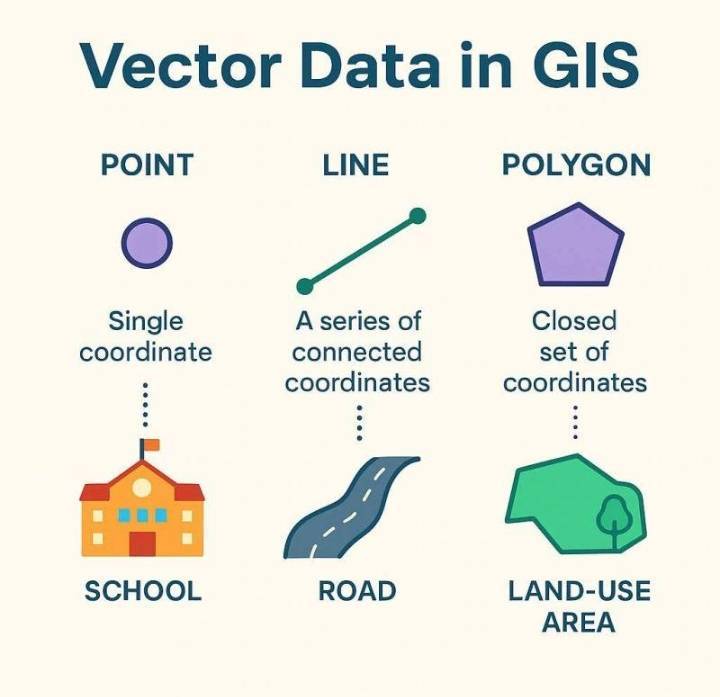
1. Vector DataVector data is used to represent geographical features through three basic elements:
Point: Represents individual locations such as trees, wells and buildings.
Line: Represents linear features such as roads, rivers and irrigation canals.
Polygon: Represents enclosed areas such as agricultural fields, lakes and administrative boundaries.
2. Raster Data
Raster data represents geographical information in the form of a collection of small square cells called pixels. Each pixel contains information about a particular location. Satellite images, rainfall maps, soil moisture maps and elevation maps are examples of raster data.
Applications of Spatial Data in Agriculture
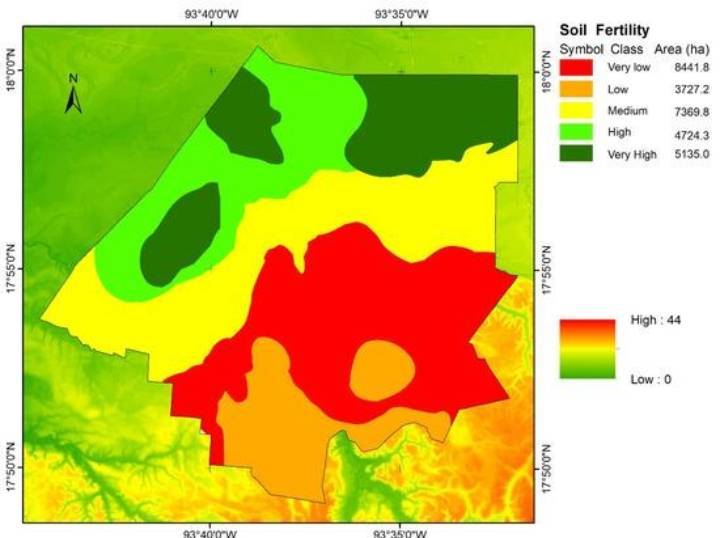
Preparation of soil fertility maps.
Identification of suitable areas for crop cultivation.
Monitoring crop growth and field conditions.
Planning irrigation and drainage systems.
Mapping agricultural land and field boundaries.
Identifying areas affected by pests and diseases.
Supporting site-specific nutrient management.
ECONOMICS – ITS SUBJECT MATTER
✓ Meaning of Economics
Economics is a social science that studies how individuals and societies make choices regarding the allocation of scarce resources to satisfy unlimited human wants.
It deals with the production, consumption and distribution of goods and services and examines how economic decisions influence individuals, businesses and society.
✓ Divisions of Economics
Economics is broadly divided into two major branches:
A. Microeconomics
Microeconomics deals with the economic behaviour of individual units such as consumers, households, firms and industries.
It studies:
- Individual consumer behaviour
- Demand and supply
- Price determination
- Production and costs
- Market structures
- Distribution of income
Agricultural Example: Studying the demand for paddy, the cost of cultivation and the price received by an individual farmer.
B. Macroeconomics
Macroeconomics studies the economy as a whole and deals with aggregate economic variables.
It studies:
- National income
- General price level
- Inflation and unemployment
- Economic growth
- Money and banking
- Public revenue and expenditure
Agricultural Example: Analysing the contribution of agriculture to national income and the impact of inflation on agricultural input prices.
✓ Modern Approach to Economics
The modern approach to economics focuses on the efficient allocation of scarce resources among competing uses to achieve maximum possible satisfaction and economic welfare.
The central economic problem arises because:
- Human wants are unlimited.
- Resources are limited.
- Resources have alternative uses.
Therefore, individuals and societies must make choices regarding the allocation of available resources.
✓Definitions of Economics
Economics has been explained through different approaches by prominent economists.
A. Wealth Definition – Adam Smith
Adam Smith, known as the Father of Economics, explained economics as the study of the nature and causes of the wealth of nations.
This approach gives importance to wealth creation and economic development.
B. Welfare Definition – Alfred Marshall
Alfred Marshall considered economics as the study of mankind in the ordinary business of life, with particular emphasis on material welfare.
This approach highlights the relationship between wealth and human welfare.
C. Scarcity Definition – Lionel Robbins
Lionel Robbins defined economics as the science that studies human behaviour as a relationship between ends and scarce means which have alternative uses.
This definition emphasizes scarcity, choice and opportunity cost.
D. Growth-Oriented Definition – Paul Samuelson
Paul Samuelson emphasized how people and societies choose to use scarce productive resources to produce different commodities over time and distribute them for present and future consumption.
This approach also considers economic growth and resource allocation.
✓Economics as a Social Science
Economics is considered a social science because it studies human behaviour and interactions in relation to the production, consumption and distribution of resources.
It examines how individuals, households, businesses and governments make economic decisions.
✓ Economics: Positive Science or Normative Science
A. Positive Economics
Positive economics deals with objective explanations of economic facts and relationships. Its statements can be examined using evidence.
Example: An increase in the market price of a commodity may influence its quantity demanded.
B. Normative Economics
Normative economics deals with value judgements and opinions about what ought to happen in an economy.
Example: The government should provide better price support to farmers to improve their income.
✓ Methods of Economic Investigation
Economic investigation involves systematic methods of studying economic problems and relationships.
A. Deductive Method
The deductive method begins with general principles or assumptions and applies them to particular situations.
It moves from general principles to specific conclusions.
B. Inductive Method
The inductive method begins with observations and specific facts and develops general principles or conclusions.
It moves from specific observations to general conclusions.
Both methods are useful in economic analysis and research.
✓ Economic Laws
Economic laws are general statements that explain the relationships between different economic variables under specified conditions.
They describe regular patterns of economic behaviour rather than absolute rules that apply without exception.
Examples:
- Law of Demand
- Law of Supply
- Law of Diminishing Marginal Utility
- Law of Diminishing Returns
Economic laws help economists understand and analyse economic activities and predict possible outcomes.
APPLICATION IN AGRICULTURE
Economics helps us understand how farmers make decisions regarding limited resources such as land, labour, capital and water.
It provides a foundation for analysing agricultural production, input costs, market prices, consumer demand and farm income.
Understanding economic principles is essential for improving resource allocation, farm efficiency and agricultural development.
Economics is fundamentally the study of scarcity, choice and resource allocation. Its principles provide the foundation for understanding individual decisions as well as the functioning of the wider economy.
"Every economic decision begins with a choice between alternative uses of limited resources."
#AgriculturalEconomics #Microeconomics #Economics
Pulses are the crops which act as major source of protein in human diet. The thing which makes pulses stand out from other crops are they are rich in protein, amino acids, vitamins and minerals. Ex: Soyabean which contains 48% of protein.
Pulse also helps in increasing the fertility of soil by Nitrogen fixation and organic matter addition.
Constraints in Pulse production:
Even though pulse crop have more nutrient availablity they have low production and productivity in India. Ex: 590-600 kg/ ha , due to
*Area under pulses are very low due to climatic hazards.
* Major pulses crop are grown in mixed, cover, marginal and inter cropping method. Farmers are not interested to grow pulses as pure crop.
* They are susceptible to water logging, pest and disease infection. This may leads to severe yield loss.
* Lack of HYV in pulses due to research in pulses.
* Initial cost of cultivation is not meet out by yield profit.
* Lack of knowledge of farmers about the cultivation practices like seed rate requirements, fertilizer requirement and application.
* Weed competition is high due to slow initial growth.
Mitigation measures to increase yield :
* Developing and using of HYV of pulses in efficient way.
* Creating awareness about pulses importance and their values in world market about farmers.
*Seed Treatment and Biofertilizers: Treat seeds with Rhizobium cultures and phosphate-solubilizing bacteria (PSB) to enhance biological nitrogen fixation and nutrient uptake.
*Climate-Resilient and High-Yielding Varieties: Shift to drought-resistant, heat-tolerant, and short-duration crop cultivars that can escape terminal heat stress and erratic rainfall patterns.
*Integrated Pest and Disease Management (IPM): Deploy yellow sticky traps, pheromone traps, bird perches, and bio-fungicides like Trichoderma alongside targeted, safe bio-pesticides or neem oil to manage pod borers, wilt, and leaf spot diseases. Remove crop residues/field sanitation to prevent fungal carryover.
* Incentives from governments to encourage the pulse farmers.
* Post-Harvest Loss Reduction: Harvest crops at proper maturity, sun-dry grains down to 10–12% moisture content before storage, and use cleaned/sealed bins to prevent storage pest infestations.
Government incentives for pulse farmers:
Major Central Government Schemes
* Mission for Aatmanirbharta in Pulses (launched October 2025): A ₹11,440 crore central scheme running from 2025–26 to 2030–31 aimed at boosting area expansion, yield, and climate-resilient seed distribution. It guarantees 100% procurement of tur, urad, and masoor for registered farmers through NAFED and NCCF at the Minimum Support Price (MSP).
*National Food Security Mission (NFSM-Pulses): Focuses on increasing production and productivity through the distribution of high-yielding variety (HYV) seeds, agronomic demonstrations, and mechanization support.
*PM-AASHA Scheme: The Pradhan Mantri Annadata Aay Sanrakshan Abhiyan safeguards farmers from distress sales by strengthening MSP implementation and price-support interventions with a major budgetary allocation.
Subsidies and Processing Support
* Seed Assistance: Farmers receive direct seed subsidies (such as up to ₹25/kg or 50% cost sharing for certified/foundation seeds) under NFSM and state agriculture programs.
*Processing Unit Subsidies: Under the new pulses mission and state-level initiatives (such as in Tamil Nadu and Bihar), eligible Farmer Producer Organisations (FPOs), self-help groups, and entrepreneurs can receive a subsidy of up to ₹25 lakh (or 33% to 50% of the project cost) to set up localized pulse processing and packaging units
INTRODUCTION Rice(oryza sativa) is the staple food crop for India and several parts of the world.At present, India is the world's largest rice producer, cultivating approximately 47 million hectares and producing nearly 158.5 million tonnes of paddy annually, with an average productivity of about 2.9 t ha⁻¹ (FOA 2023)
There are many new and modern technologies that are developed particularly for rice. The technologies are developed across the world.
Aerobic rice
•Aerobic rice production is cultivated in non-puddled and nonsaturated soils.This is suitable for uplands, slope areas and water insufficient areas and protective irritated lands.
•Problems:
Weeds
Iron deficiency
Advantages
•Better soil and crop management
•Water saving upto 30 to 50%
•Lower cost
2. Golden rice
•The genetically engineered beta carotene rice popularly known as golden rice.
•Developed by Dr Ingo Potrykus and Dr Peter Bayer team in Zurich, Switzerland.
•The US Food and Drug Administration has classified it as genetically acceptable and safe
•Genetically modified rice containing Vitamin-A precursor Beta Carotene. Grains look yellow /golden colour. Good for night blindness.
Advantages
•Combats vitamin A deficiency
•No extra costs to farmers
•Preserves standard rice quality
3.super rice
•It is genetically engineered strain of rice varieties which could yield more than13 tonnes/ha (35% more yield)
•Genetic material from maize was inserted into rice plant including the gene for pyruvate -ortho- phosphate dikinase
•US scientist Prof. Maurice developed the super rice var
Advantages
•High yield upto 20 to 30% more grains
•Extreme climate resilience
•Resources and cost efficiency
•Enhanced nutrition profile
4 PARBOILED RICE (KUCHALAKKI)
A hydrothermal treatment of rice grain immediately followed by drying prior to milling to prepare parboiled grains is called parboiling.
In hypthermal process the crystalline process change into amorphous form.
Advantages
•Easy to shell
•Amount of broken rice is reduced
•more nutritious than raw rice
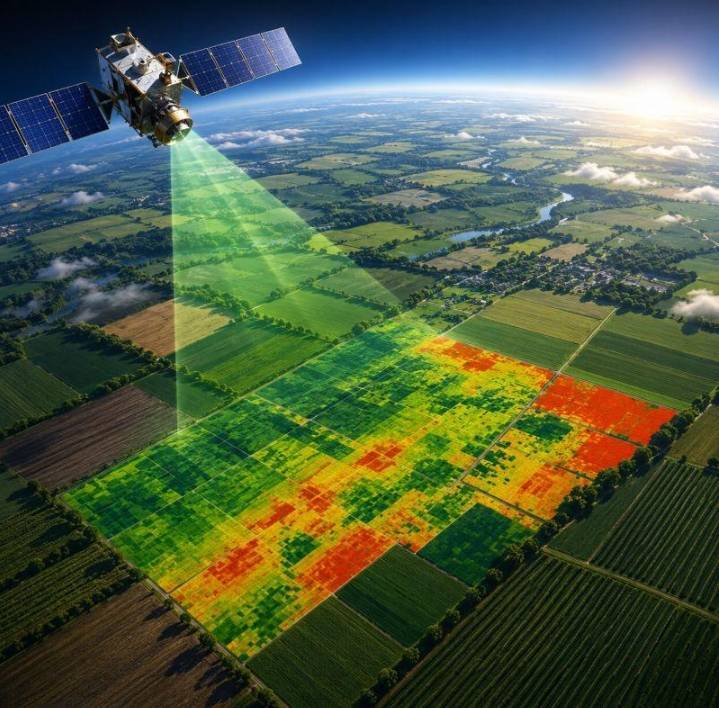
Remote Sensing: Uses its own energy source and records the reflected signal. Example: RADAR and LiDAR.
COMPONENTS
Energy source: Sun or artificial energy.
Atmosphere: Medium through which energy travels.
Target: Object or area being studied.
Sensor: Detects reflected or emitted energy.
Data processing: Converts collected data into useful information.
Interpretation: Analyses the information for decision-making.
APPLICATION IN AGRICULTURE
*Crop health monitoring.
Identification of crop diseases and nutrient deficiencies.
Soil moisture assessment.
Drought monitoring.
Crop acreage estimation.
Yield prediction.
Irrigation management.
Flood and disaster assessment.
ADVANTAGES:
Covers large geographical areas.
Saves time and labour.
Provides repeated observations.
Helps in precision agriculture.
Supports better farm management.
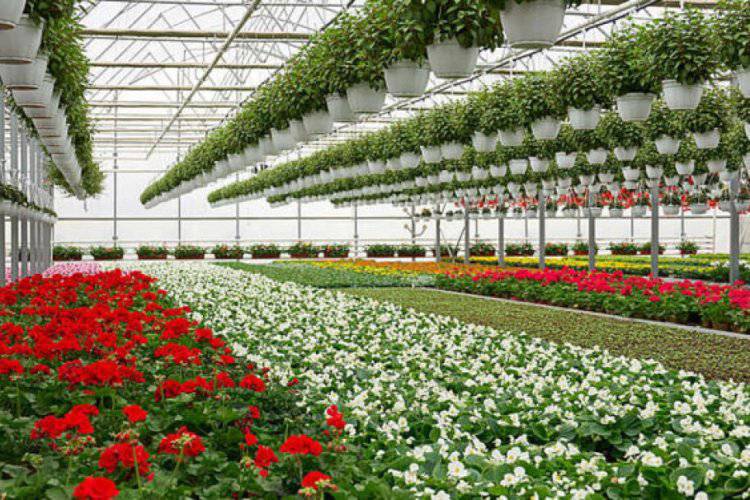
What is floriculture?Floriculture is a branch of horticulture that deals with the cultivation, production, harvesting, and marketing of flowers and ornamental plants.
It includes growing flowers for decoration, gardens, bouquets, religious ceremonies, landscaping, and commercial sale.
Examples: Rose, jasmine, marigold, chrysanthemu
Types of flowers:
1.Cut flowers
Flowers grown for cutting and arranging in bouquets and floral decorations.
Examples: Rose, carnation, gerbera, gladiolus.
2. Pot plants
Flowering and ornamental plants grown in pots for indoor and outdoor decoration.
Examples: Chrysanthemum, anthurium, kalanchoe.
3. Loose flowers
Flowers harvested without long stems for garlands, worship, and traditional decorations.
Examples: Jasmine, marigold, crossandra, tuberose.
4. Landscape gardening
Growing and arranging ornamental plants in gardens, parks, campuses, and public spaces.
Examples: Bougainvillea, hibiscus, ixora.
Methods of propagation
*Sexual propagation – Seeds:
Used for crops such as marigold, petunia, and zinnia.
*Vegetative propagation:
Includes cuttings, layering, grafting, bulbs, corms, rhizomes, and suckers, depending on the plant.
*Tissue culture:
Produces large numbers of uniform, healthy planting materials under controlled laboratory conditions.
Importance of floriculture:
Economic benefits: Generates income for farmers and entrepreneurs.
Employment: Creates jobs in cultivation, nurseries, packaging, transport, and floral design.
Export potential: Some cut flowers and ornamental plants have international markets.
Cultural importance: Flowers are widely used in religious ceremonies, weddings, and festivals.
Environmental value: Ornamental plants improve landscapes and can support pollinators when appropriate species are selected.
Industrial uses: Flowers supply raw materials for perfumes, cosmetics, essential oils, and certain traditional products.
Floriculture in India:
India has a diverse floriculture industry because of its varied climates and growing conditions. Major commercial flowers include rose, jasmine, marigold, chrysanthemum, tuberose, and gerbera.
Important flower-growing regions include Karnataka, Tamil Nadu, West Bengal,
Maharashtra, and Andhra Pradesh, among others.
In Tamil Nadu, jasmine, marigold, chrysanthemum, and other traditional flowers are important for domestic markets, religious uses, and garland making.
Commercial flower farming:
*Flower nursery management
*Greenhouse and polyhouse cultivation
*Bouquet and floral arrangement businesses
*Landscaping and garden design
*Flower drying and value-added products
*Floriculture marketing and exports
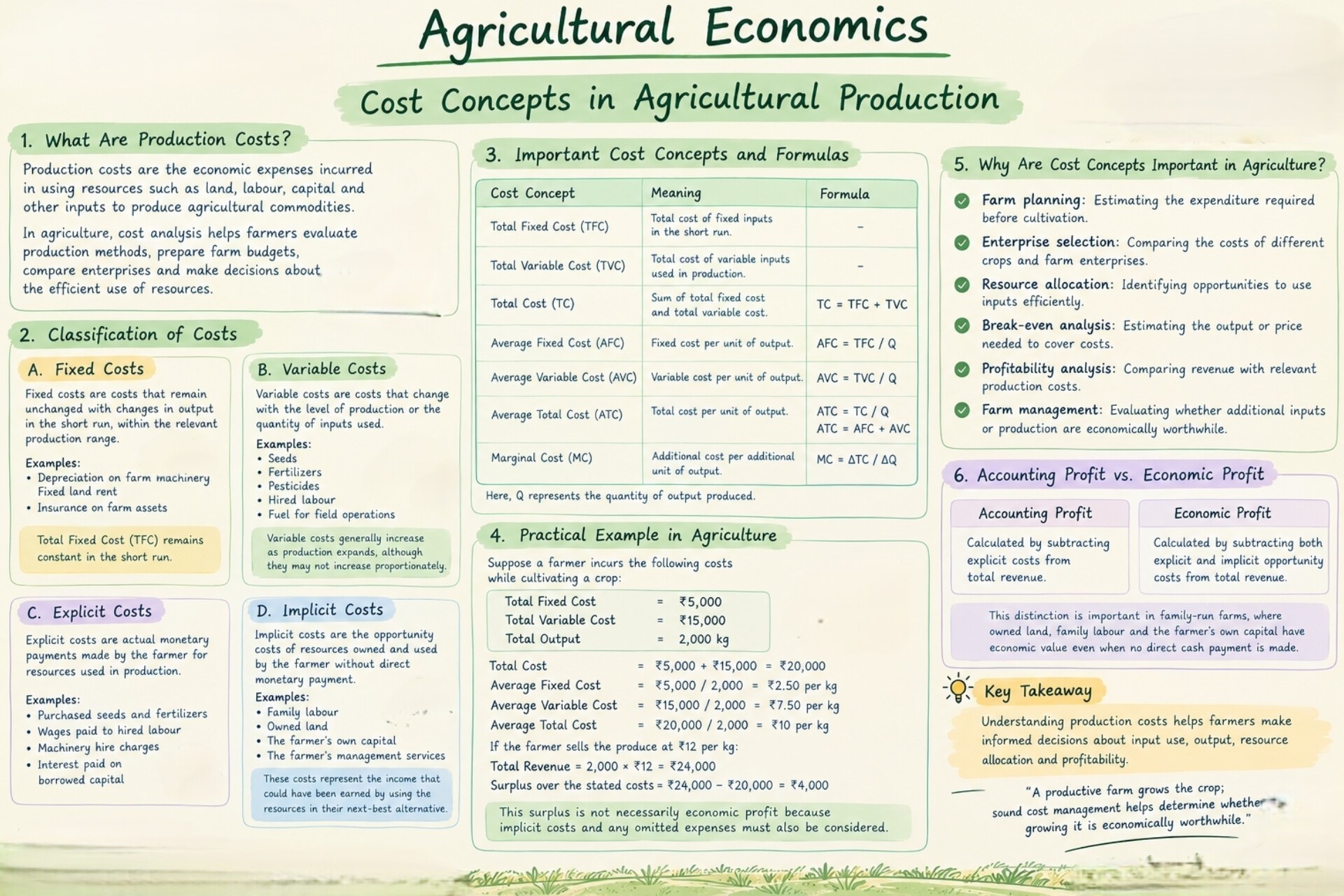
AGRICULTURAL ECONOMICS
COST CONCEPTS IN AGRICULTURAL PRODUCTION
1. What Are Production Costs?
Production costs are the economic expenses incurred in using resources such as land, labour, capital and other inputs to produce agricultural commodities.
In agriculture, cost analysis helps farmers evaluate production methods, prepare farm budgets, compare enterprises and make decisions about the efficient use of resources.
2. Classification of Costs
A. Fixed Costs
Fixed costs are costs that remain unchanged with changes in output in the short run, within the relevant production range.
Examples:
- Depreciation on farm machinery
- Fixed land rent
- Insurance on farm assets
Total Fixed Cost (TFC) remains constant in the short run, even when output changes.
B. Variable Costs
Variable costs are costs that change with the level of production or the quantity of inputs used.
Examples:
- Seeds
- Fertilizers
- Pesticides
- Hired labour
- Fuel for field operations
Variable costs generally increase as production expands, although they may not increase proportionately.
C. Explicit Costs
Explicit costs are actual monetary payments made by the farmer for resources used in production.
Examples:
- Purchased seeds and fertilizers
- Wages paid to hired labour
- Machinery hire charges
- Interest paid on borrowed capital
D. Implicit Costs
Implicit costs are the opportunity costs of resources owned and used by the farmer without direct monetary payment.
Examples:
- Family labour
- Owned land
- The farmer's own capital
- The farmer's management services
These costs represent the income that could have been earned by using the resources in their next-best alternative.
3. Important Cost Concepts and Formulas
Total Fixed Cost (TFC): The total cost of fixed inputs in the short run.
Total Variable Cost (TVC): The total cost of variable inputs used in production.
Total Cost (TC): The sum of total fixed cost and total variable cost.
TC = TFC + TVC
Average Fixed Cost (AFC): Fixed cost per unit of output.
AFC = TFC / Q
Average Variable Cost (AVC): Variable cost per unit of output.
AVC = TVC / Q
Average Total Cost (ATC): Total cost per unit of output.
ATC = TC / Q
ATC = AFC + AVC
Marginal Cost (MC): The additional cost incurred by producing one more unit of output.
MC = Change in TC / Change in Q
Here, Q represents the quantity of output produced.
4. Practical Example in Agriculture
Suppose a farmer incurs the following costs while cultivating a crop:
Total Fixed Cost = ₹5,000
Total Variable Cost = ₹15,000
Total Output = 2,000 kg
Total Cost = ₹5,000 + ₹15,000 = ₹20,000
Average Fixed Cost = ₹5,000 / 2,000 = ₹2.50 per kg
Average Variable Cost = ₹15,000 / 2,000 = ₹7.50 per kg
Average Total Cost = ₹20,000 / 2,000 = ₹10 per kg
If the farmer sells the produce at ₹12 per kg:
Total Revenue = 2,000 × ₹12 = ₹24,000
Surplus over the stated costs = ₹24,000 − ₹20,000 = ₹4,000
This surplus is not necessarily economic profit because implicit costs and any omitted expenses must also be considered.
5. Why Are Cost Concepts Important in Agriculture?
- Farm planning: Estimating the expenditure required before cultivation.
- Enterprise selection: Comparing the costs of different crops and farm enterprises.
- Resource allocation: Identifying opportunities to use inputs efficiently.
- Break-even analysis: Estimating the output or price needed to cover costs.
- Profitability analysis: Comparing revenue with relevant production costs.
- Farm management: Evaluating whether additional inputs or production are economically worthwhile.
6. Accounting Profit vs. Economic Profit
Accounting profit is calculated by subtracting explicit costs from total revenue.
Economic profit is calculated by subtracting both explicit and implicit opportunity costs from total revenue.
This distinction is important in family-run farms, where owned land, family labour and the farmer's own capital have economic value even when no direct cash payment is made.
KEY TAKEAWAY
Understanding production costs helps farmers make informed decisions about input use, output, resource allocation and profitability.
“A productive farm grows the crop; sound cost management helps determine whether growing it is economically worthwhile.”
#AgriculturalEconomics #AgriEconomics #FarmManagement
GIS
GIS stands for Geographic Information System. It is a computer-based system used to collect, store, manage, analyse and display geographical data.
Soil Fertility Mapping: Identifies soil types, pH and nutrient distribution.Crop Monitoring: Helps monitor crop growth and identify unhealthy areas.
Fertilizer Management: Supports site-specific fertilizer application based on soil and crop requirements.
Irrigation Management: Helps plan irrigation according to soil properties and field conditions.
Yield Mapping: Identifies variations in crop yield across a field.
Pest and Disease Management: Maps affected areas to support targeted management.
Land Use Mapping: Helps identify agricultural land boundaries and land-use patterns.
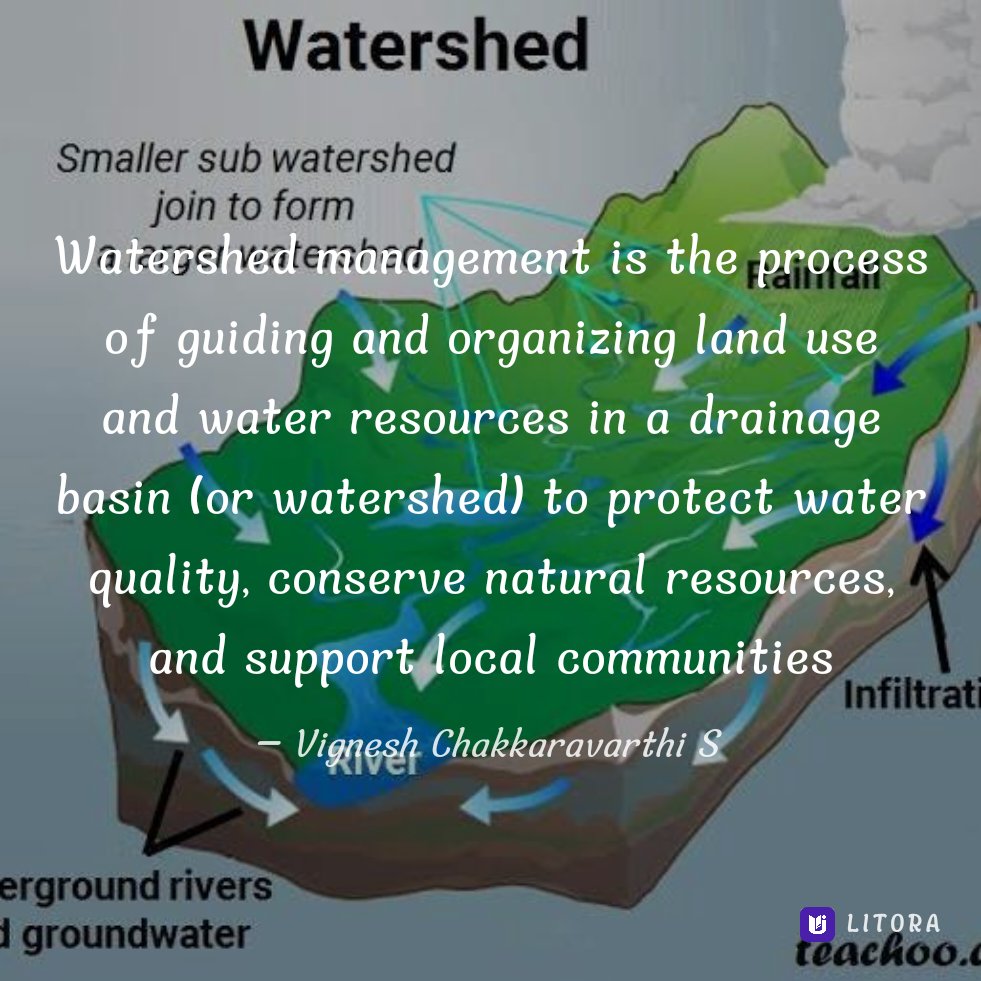
Watershed Management: Supports water conservation and soil erosion control.
Components of GIS:
Hardware
Software
Data
People
Methods
This is the basic info about GIS