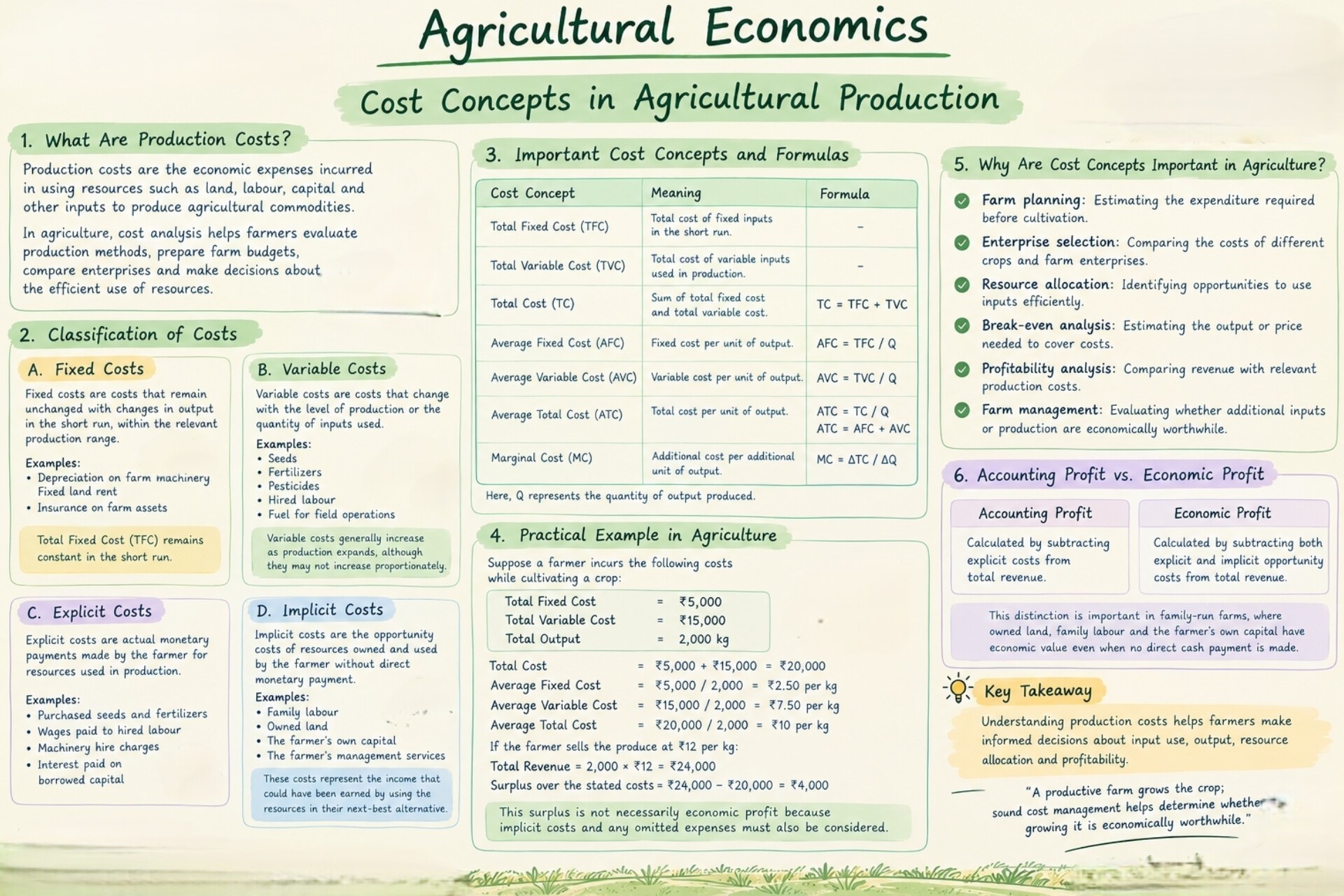
COST CONCEPTS IN AGRICULTURAL PRODUCTION

AGRICULTURAL ECONOMICS
COST CONCEPTS IN AGRICULTURAL PRODUCTION
1. What Are Production Costs?
Production costs are the economic expenses incurred in using resources such as land, labour, capital and other inputs to produce agricultural commodities.
In agriculture, cost analysis helps farmers evaluate production methods, prepare farm budgets, compare enterprises and make decisions about the efficient use of resources.
2. Classification of Costs
A. Fixed Costs
Fixed costs are costs that remain unchanged with changes in output in the short run, within the relevant production range.
Examples:
- Depreciation on farm machinery
- Fixed land rent
- Insurance on farm assets
Total Fixed Cost (TFC) remains constant in the short run, even when output changes.
B. Variable Costs
Variable costs are costs that change with the level of production or the quantity of inputs used.
Examples:
- Seeds
- Fertilizers
- Pesticides
- Hired labour
- Fuel for field operations
Variable costs generally increase as production expands, although they may not increase proportionately.
C. Explicit Costs
Explicit costs are actual monetary payments made by the farmer for resources used in production.
Examples:
- Purchased seeds and fertilizers
- Wages paid to hired labour
- Machinery hire charges
- Interest paid on borrowed capital
D. Implicit Costs
Implicit costs are the opportunity costs of resources owned and used by the farmer without direct monetary payment.
Examples:
- Family labour
- Owned land
- The farmer's own capital
- The farmer's management services
These costs represent the income that could have been earned by using the resources in their next-best alternative.
3. Important Cost Concepts and Formulas
Total Fixed Cost (TFC): The total cost of fixed inputs in the short run.
Total Variable Cost (TVC): The total cost of variable inputs used in production.
Total Cost (TC): The sum of total fixed cost and total variable cost.
TC = TFC + TVC
Average Fixed Cost (AFC): Fixed cost per unit of output.
AFC = TFC / Q
Average Variable Cost (AVC): Variable cost per unit of output.
AVC = TVC / Q
Average Total Cost (ATC): Total cost per unit of output.
ATC = TC / Q
ATC = AFC + AVC
Marginal Cost (MC): The additional cost incurred by producing one more unit of output.
MC = Change in TC / Change in Q
Here, Q represents the quantity of output produced.
4. Practical Example in Agriculture
Suppose a farmer incurs the following costs while cultivating a crop:
Total Fixed Cost = ₹5,000
Total Variable Cost = ₹15,000
Total Output = 2,000 kg
Total Cost = ₹5,000 + ₹15,000 = ₹20,000
Average Fixed Cost = ₹5,000 / 2,000 = ₹2.50 per kg
Average Variable Cost = ₹15,000 / 2,000 = ₹7.50 per kg
Average Total Cost = ₹20,000 / 2,000 = ₹10 per kg
If the farmer sells the produce at ₹12 per kg:
Total Revenue = 2,000 × ₹12 = ₹24,000
Surplus over the stated costs = ₹24,000 − ₹20,000 = ₹4,000
This surplus is not necessarily economic profit because implicit costs and any omitted expenses must also be considered.
5. Why Are Cost Concepts Important in Agriculture?
- Farm planning: Estimating the expenditure required before cultivation.
- Enterprise selection: Comparing the costs of different crops and farm enterprises.
- Resource allocation: Identifying opportunities to use inputs efficiently.
- Break-even analysis: Estimating the output or price needed to cover costs.
- Profitability analysis: Comparing revenue with relevant production costs.
- Farm management: Evaluating whether additional inputs or production are economically worthwhile.
6. Accounting Profit vs. Economic Profit
Accounting profit is calculated by subtracting explicit costs from total revenue.
Economic profit is calculated by subtracting both explicit and implicit opportunity costs from total revenue.
This distinction is important in family-run farms, where owned land, family labour and the farmer's own capital have economic value even when no direct cash payment is made.
KEY TAKEAWAY
Understanding production costs helps farmers make informed decisions about input use, output, resource allocation and profitability.
“A productive farm grows the crop; sound cost management helps determine whether growing it is economically worthwhile.”
#AgriculturalEconomics #AgriEconomics #FarmManagement