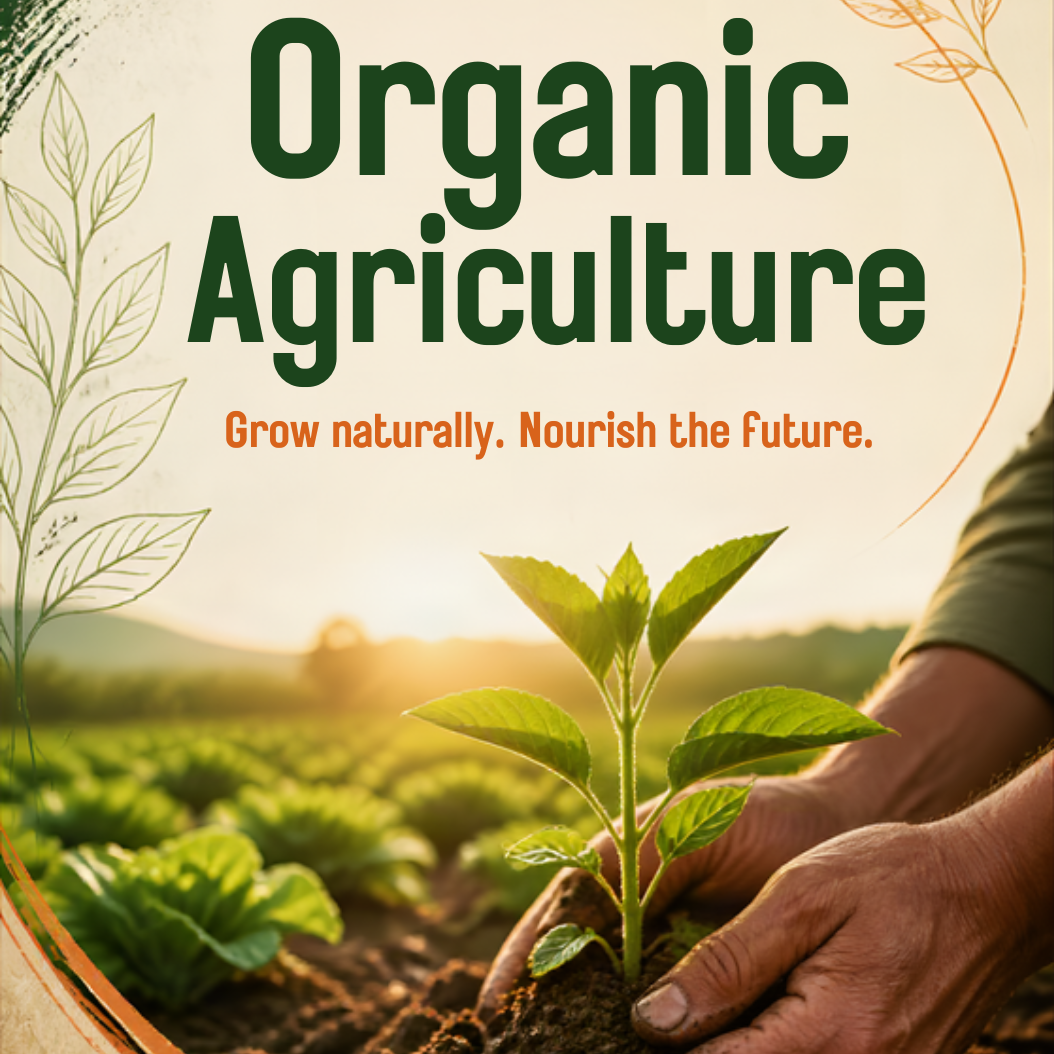
Organic agriculture

# Organic Agriculture: Farming for a Healthy Soil and Sustainable Future
## Introduction
Agriculture is the foundation of human civilization, providing food, fibre, fodder and raw materials for industries. However, intensive agricultural practices and excessive dependence on synthetic fertilizers and pesticides can contribute to soil degradation, water pollution, loss of biodiversity and other environmental concerns.
**Organic agriculture** provides a farming approach that emphasizes ecological processes, biological cycles and the responsible use of natural resources.
Organic agriculture is not simply the replacement of chemical fertilizers with organic manures. It is a holistic farming system that aims to maintain soil fertility, support biodiversity, recycle farm resources and produce safe and nutritious food while protecting the environment.
What is Organic Agriculture?
Organic agriculture is a production system that works with natural ecological processes. It promotes the use of organic manures, compost, crop residues, green manures, biological pest-control methods and other naturally derived inputs.
The main objective is to maintain a healthy relationship between **soil, plants, animals, microorganisms and the environment**. Instead of depending heavily on external synthetic inputs, organic farming encourages recycling of nutrients within the farm.
Principles of Organic Agriculture
Organic agriculture is based on several important principles:
1. **Maintaining soil health** – Healthy soil is the foundation of productive agriculture.
2. **Nutrient recycling** – Crop residues, animal manures and other organic materials are recycled as nutrient sources.
3. **Biodiversity conservation** – Diverse crops, beneficial insects, microorganisms and other organisms are encouraged.
4. **Ecological pest management** – Biological, cultural and mechanical methods are used to manage pests.
5. **Efficient resource use** – Water, soil, energy and other farm resources are used responsibly.
6. **Environmental protection** – Farming practices should minimize pollution and protect natural ecosystems.
7. **Sustainable production** – Agricultural productivity should be maintained without compromising the ability of future generations to produce food.
## Major Practices in Organic Agriculture
### 1. Organic Manures and Compost
Farmyard manure, compost, vermicompost and other organic materials improve soil structure and contribute nutrients. They also support beneficial soil microorganisms.
### 2. Green Manuring
Green manure crops are grown and incorporated into the soil while they are still green. Leguminous green manure crops can contribute nitrogen and organic matter to the soil.
### 3. Crop Rotation
Growing different crops in sequence helps maintain soil fertility, disrupt pest and disease cycles and improve the efficient use of nutrients.
### 4. Cover Cropping and Mulching
Cover crops protect the soil from erosion and help conserve moisture. Mulching with suitable organic materials can reduce evaporation, suppress weeds and add organic matter as it decomposes.
### 5. Biological Pest Management
Organic agriculture encourages the use of beneficial organisms such as predators, parasitoids and microbial biocontrol agents. Cultural and mechanical methods are also important components of pest management.
### 6. Integrated Weed Management
Weeds can be managed through crop rotation, mulching, hand weeding, mechanical methods, competitive crops and other appropriate practices rather than relying primarily on synthetic herbicides.
### 7. Livestock Integration
Animals can contribute manure, fodder cycling and additional farm income. Integrating crops and livestock can improve nutrient recycling within the farming system.
## Benefits of Organic Agriculture
Organic agriculture provides several potential benefits when properly planned and managed.
**Improved soil health:** Regular addition of organic matter can improve soil structure, water-holding capacity and biological activity.
**Environmental protection:** Reduced dependence on synthetic agricultural inputs can help minimize certain forms of soil and water contamination.
**Biodiversity conservation:** Diverse cropping systems and ecological pest-management practices can provide better conditions for beneficial organisms.
**Resource recycling:** Crop residues, livestock manure and other biodegradable materials can be converted into useful resources.
**Sustainable farming:** Organic systems emphasize maintaining the productivity and ecological functions of agricultural land over the long term.
**Potential livelihood opportunities:** Organic products can provide market opportunities for farmers when suitable production, certification, processing and marketing systems are available.
## Challenges of Organic Agriculture
Despite its advantages, organic agriculture also faces challenges. Conversion from conventional farming to organic systems may require changes in farm management and investment in knowledge and infrastructure. Nutrient management can be more complex because nutrients from organic sources are released gradually. Weed, pest and disease management may require careful monitoring and timely intervention.
Farmers may also face challenges related to certification, availability of suitable organic inputs, market access, storage, processing and obtaining appropriate prices. Therefore, successful organic farming requires **technical knowledge, good planning, suitable crop selection and reliable markets**.
## Role of Farmers and Consumers
Farmers play a central role in developing sustainable agricultural systems. Proper soil management, crop diversification, recycling of organic resources and ecological pest management can strengthen farm sustainability.
Consumers also have an important role. Awareness about organic production, responsible purchasing and understanding certification and labeling can support transparent organic markets.
## Organic Agriculture and the Future
The future of agriculture requires a balance between food production, environmental protection and efficient resource use. Organic agriculture contributes to this goal by placing greater emphasis on soil health, biodiversity, nutrient recycling and ecological processes.
Modern technologies can also complement organic farming. Digital agriculture, weather information, precision irrigation, remote sensing and improved biological inputs can help farmers make better decisions while maintaining organic production principles.
## Conclusion
**Organic agriculture is more than a method of producing food; it is an approach to farming that places soil, biodiversity and ecological sustainability at the centre of agricultural production.** By improving soil health, recycling farm resources, conserving biodiversity and using environmentally responsible management practices, organic agriculture can contribute to a more sustainable food system.
The future of farming depends not only on how much food we produce, but also on **how responsibly we use the soil, water and natural resources that make food production possible**. Healthy soil today can help create a healthier and more sustainable agricultural future for generations to come.