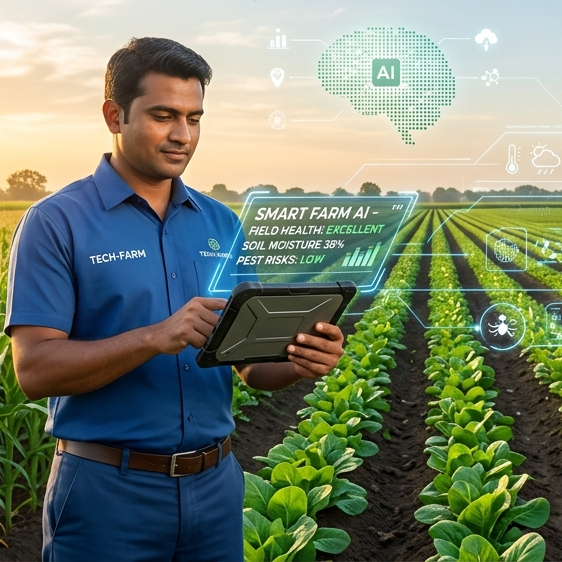
Artificial Intelligence in Agriculture: Transform your Farm

# Artificial Intelligence in Agriculture: Transform your Farm
## Introduction
Agriculture is the backbone of the Indian economy and provides the mainstay for food and nutritional security. However, the agriculture sector in a changing world is challenged by climate change, water scarcity, soil health deterioration, pests and diseases, rising input costs, diminishing farm labour, and an increasing demand for food. The solution to many of these challenges lies in newer technologies.
One such game-changing technology that is set to revolutionize and transform the agriculture sector is Artificial Intelligence (AI). AI is the ability of computer systems and robots to mimic and execute tasks that are usually done by humans such as thinking, learning, understanding, reasoning, problem-solving, seeing, hearing, and moving. When combined with sensors, drones, satellites, robots, smartphones, and agricultural machinery, artificial intelligence has the potential to make farming more precise, productive, efficient, profitable, and sustainable.
In this article, we will learn what AI is, major applications of AI in agriculture, key benefits, and challenges for Indian farmers.
## What is Artificial Intelligence (AI) in Agriculture?
Artificial intelligence in agriculture is the application of computer algorithms and machine learning techniques to learn from and analyze agricultural data to make useful decisions and information for farming. The information can come from various sources such as sensors, satellites, drones, farm machinery, smartphones, and farm records.
Artificial intelligence algorithms can process all this information and help farmers make decisions regarding:
- Choice of crops
- Soil and nutrient management
- Irrigation
- Pest and disease identification
- Weed detection
- Yield estimation
- Weather forecasting
- Harvesting
- Market and price prediction
Thus AI helps take agriculture decision-making from traditional practices to data-informed precision agriculture.
## Major Applications of AI in Agriculture
### 1. AI Based Crop Monitoring
AI can analyze the images collected via drones, satellites, and smartphones to assess the crop. It can detect subtle changes in leaf color, plant height, canopy cover, and health of the crop.
For instance, the AI can detect specific areas in the field that may be lacking nutrients and advise targeted applications to address the deficiency instead of applying fertilizers to the whole field.
### 2. Pest and Disease Detection
Pests and diseases can cause devastating losses if not detected and managed in time. AI image recognition algorithms can detect symptoms on leaves, fruits, stems, and other plant parts.
A farmer can take a picture of the sick plant and send it to an AI-based mobile application by which it can compare and identify the type of disease by accessing its database. With early detection, the farmer can make decisions regarding pesticides, protect the yield, and reduce crop losses.
### 3. Precision Irrigation
Water is one of the most critical inputs in farming. AI can analyze the information from soil-moisture sensors, weather forecast, crop type, and its evapotranspiration rate, and prescribe the right amount of water at the right time.
AI-based precision irrigation can automatically control the irrigation system to meet the crop-water requirements. This would save water, improve water use efficiency, and enhance crop productivity.
### 4. Soil and Nutrient Management
AI can analyze data from soil test reports and other field data to prescribe nutrient management practices.
Instead of broadcasting fertilizers at uniform rates, AI can help identify field variability and help in precision placement and application of fertilizers. This would reduce fertilizer use and environmental pollution.
### 5. Weed Detection and Management
Weeds are a serious threat to a healthy crop. AI-powered visual recognition technology via cameras and drones can identify and differentiate between crops and weeds. AI-powered machines can then selectively kill weeds without affecting the crop. This would reduce herbicides use and help precision weed management.
### 6. Yield Prediction
AI can analyze field data such as past yield records, weather, soil health, crop type, and input use to predict the crop yield before harvest.
Yield prediction helps farmers, traders, food processing industries, and government make suitable plans regarding stocks, food security, and market availability.
### 7. Weather and Climatic Decision Support
Weather and climate have a huge impact on farming. AI can help identify trends from voluminous weather and field data to provide intelligence to farmers. Farmers can then use this data regarding changing weather patterns to decide:
- What to grow
- When to sow
- When to irrigate
- When to apply fertilizers
- When to spray pesticides
- When to harvest
- Take farm management decisions
### 8. Agricultural Robotics
Agricultural robots or agri-bots can be used for weeding, placing seeds, monitoring crops, and harvesting fruits. AI enables these robots to recognize plant species and objects and perform specific farm tasks.
### 9. Smart Greenhouses
AI can be used in conjunction with sensors to monitor and control variables such as temperature, humidity, light intensity, carbon dioxide levels, and soil moisture in greenhouses for better yield.
### 10. AI Based Agricultural Advisory
AI-based mobile applications and platforms can provide farm-specific information to farmers. A farmers can get information about what to grow, how to manage pests and diseases, fertilizer application, irrigation, weather, and market intelligence. Further, AI-based agricultural advisory can be made accessible to farmers in local languages.
## Integration of AI with Other Technologies
The power of AI increases manifold when it is integrated with other technologies. Some of the key technologies along with AI that can be used in agriculture are provided below:
| Technology | Role in Agriculture |
| --- | --- |
| Artificial Intelligence | Decision-making and prediction |
| Internet of Things (IoT) | Farm data collection |
| Drones | Crop imaging and monitoring |
| Remote sensing | Crop assessment |
| Robotics | Farm operations automation |
| GPS/ GIS | Farm mapping |
| Cloud computing | Storing and analyzing farm data |
| Smartphones | Access to AI apps by farmers |
| Blockchain | Traceability and accountability |
The convergence of all these technologies has given rise to smart farms and precision agriculture or agriculture 4.0.
## Benefits of AI in Agriculture
AI has multiple benefits that can make farms more productive and profitable. It can provide the following advantages:
1. Higher crop productivity
2. Early pest and disease detection
3. Efficient use of water
4. Efficient fertilizer application
5. Less use of pesticides
6. Lower cost of production
7. Less dependence on labour
8. Better farm decisions
9. Yield prediction
10. Efficient use of resources
11. Reduced environmental impact
12. Higher resilience to climate change
## Challenges in Adopting AI
Challenges of AI adoption are multifactorial and include:
### 1. High Cost of Adoption
The cost of setting up AI-based precision farming with various sensors and machines may be beyond the means of small and marginal farmers.
### 2. Lack of Digital Literacy
Farmers will need training and capacity building to use AI-based technologies.
### 3. Poor Internet Connectivity
The penetration of digital technologies in rural areas is poor.
### 4. Data Availability
AI algorithms require volumes of data to make intelligent decisions. In many cases, the data may be poor in quality and quantity.
### 5. Agricultural Land Size and Holding Pattern
Most Indian farmers have small and fragmented land holdings on which the adoption of capital-intensive technology may not be viable.
### 6. Need for Local Technologies
Most AI tools are developed using data from western countries which may not be useful in Indian conditions. There is a need to develop local AI algorithms using local data. Similarly, there is a need to translate these technologies into local languages.
## Future Prospects
The future of farming undoubtedly lies in convergence with robotics, drones, AI, IoT, remote sensing, and satellites.
The future of AI is exciting as it will enable giving digital intelligence to farms. A farmer may just take a picture of the farm and get information about crop health, soil fertility, pest problems, and weather forecast from a mobile application. AI may also make farming autonomous - when machines perform various agricultural operations with little or no human supervision. For India, which has diverse climatic conditions, diverse crops, diverse soil types, diverse pests and diseases, AI can be a real blessing. However, the technologies need to be affordable and available in local languages to reach out to millions of Indian farmers.
## Conclusion
Artificial intelligence is poised to play a major role in future precision agriculture. AI has the potential to make smarter decisions based on the massive volumes of agricultural data it can analyze to improve crop productivity and farm profitability. However, AI needs to be seen as a supportive decision-making tool rather than a fully automated system that replaces human decisions. Coupled with precision agriculture, IoT, and robotics, AI can make agriculture more productive, profitable, climate-resilient, and sustainable.